
Act 5, Scene 3
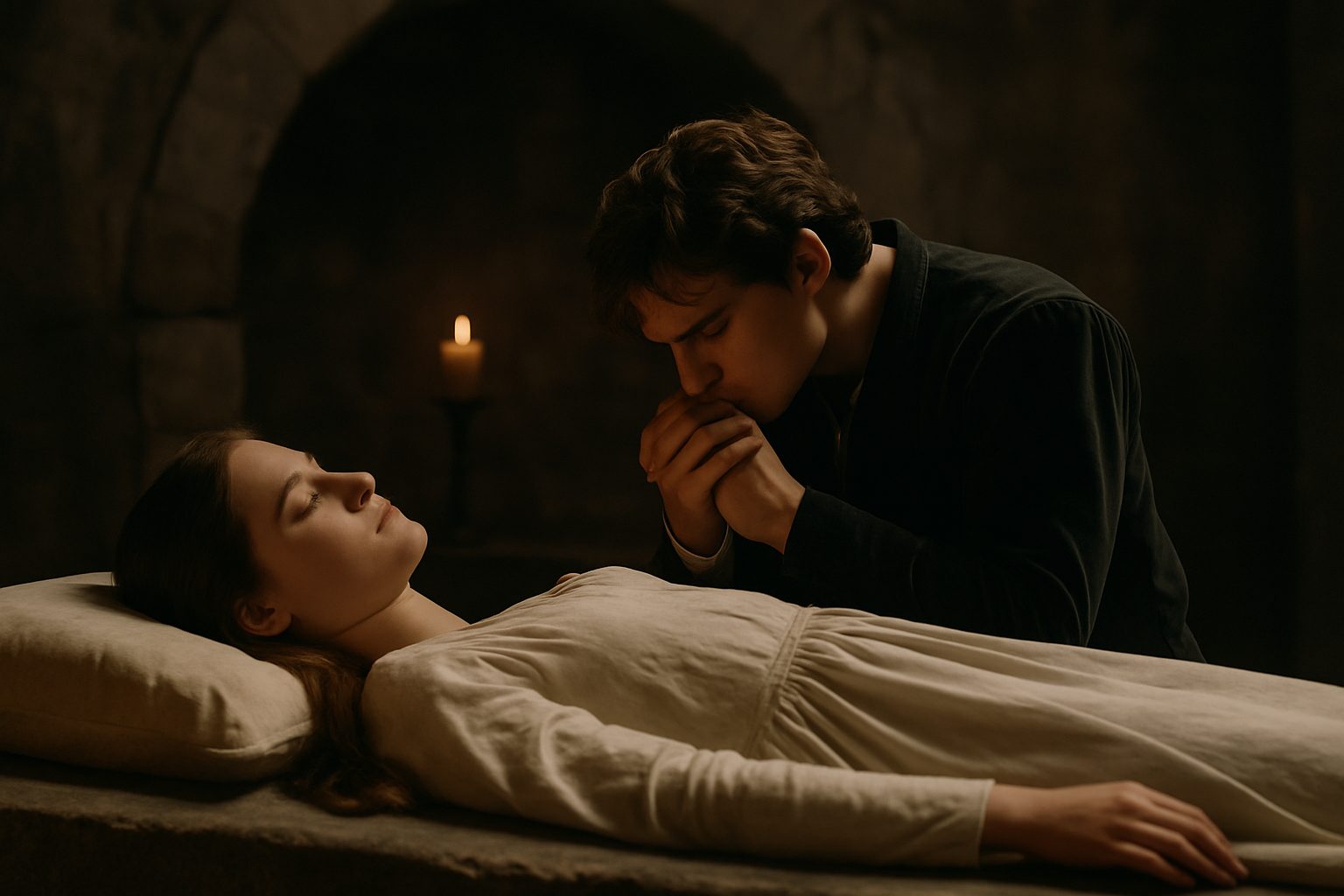
[Enter Paris and his Page.]
PARIS
Give me thy torch, boy. Hence and stand aloof.
Yet put it out, for I would not be seen.
Under yond yew trees lay thee all along,
Holding thy ear close to the hollow ground.
So shall no foot upon the churchyard tread
(Being loose, unfirm, with digging up of graves)
But thou shalt hear it. Whistle then to me
As signal that thou hearest something approach.
Give me those flowers. Do as I bid thee. Go.
PAGE, [aside]
I am almost afraid to stand alone
Here in the churchyard. Yet I will adventure.
[He moves away from Paris.]
PARIS, [scattering flowers]
Sweet flower, with flowers thy bridal bed I strew
(O woe, thy canopy is dust and stones!)
Which with sweet water nightly I will dew,
Or, wanting that, with tears distilled by moans.
The obsequies that I for thee will keep
Nightly shall be to strew thy grave and weep.
[Page whistles.]
The boy gives warning something doth approach.
What cursed foot wanders this way tonight,
To cross my obsequies and true love's rite?
What, with a torch? Muffle me, night, awhile.
[He steps aside.]
[Enter Romeo and Balthasar.]
ROMEO
Give me that mattock and the wrenching iron.
Hold, take this letter. Early in the morning
See thou deliver it to my lord and father.
Give me the light. Upon thy life I charge thee,
Whate'er thou hearest or seest, stand all aloof
And do not interrupt me in my course.
Why I descend into this bed of death
Is partly to behold my lady's face,
But chiefly to take thence from her dead finger
A precious ring, a ring that I must use
In dear employment. Therefore hence, begone.
But, if thou, jealous, dost return to pry
In what I farther shall intend to do,
By heaven, I will tear thee joint by joint
And strew this hungry churchyard with thy limbs.
The time and my intents are savage-wild,
More fierce and more inexorable far
Than empty tigers or the roaring sea.
BALTHASAR
I will be gone, sir, and not trouble you.
ROMEO
So shalt thou show me friendship. Take thou that.
[Giving money.]
Live and be prosperous, and farewell, good fellow.
BALTHASAR, [aside]
For all this same, I'll hide me hereabout.
His looks I fear, and his intents I doubt.
[He steps aside.]
ROMEO, [beginning to force open the tomb]
Thou detestable maw, thou womb of death,
Gorged with the dearest morsel of the earth,
Thus I enforce thy rotten jaws to open,
And in despite I'll cram thee with more food.
PARIS
This is that banished haughty Montague
That murdered my love's cousin, with which grief
It is supposed the fair creature died,
And here is come to do some villainous shame
To the dead bodies. I will apprehend him.
[Stepping forward.]
Stop thy unhallowed toil, vile Montague.
Can vengeance be pursued further than death?
Condemned villain, I do apprehend thee.
Obey and go with me, for thou must die.
ROMEO
I must indeed, and therefore came I hither.
Good gentle youth, tempt not a desp'rate man.
Fly hence and leave me. Think upon these gone.
Let them affright thee. I beseech thee, youth,
Put not another sin upon my head
By urging me to fury. O, begone!
By heaven, I love thee better than myself,
For I come hither armed against myself.
Stay not, begone, live, and hereafter say
A madman's mercy bid thee run away.
PARIS
I do defy thy commination
And apprehend thee for a felon here.
ROMEO
Wilt thou provoke me? Then have at thee, boy!
[They draw and fight.]
PAGE
O Lord, they fight! I will go call the watch.
[He exits.]
PARIS
O, I am slain! If thou be merciful,
Open the tomb; lay me with Juliet. [He dies.]
ROMEO
In faith, I will.--Let me peruse this face.
Mercutio's kinsman, noble County Paris!
What said my man when my betossed soul
Did not attend him as we rode? I think
He told me Paris should have married Juliet.
Said he not so? Or did I dream it so?
Or am I mad, hearing him talk of Juliet,
To think it was so?--O, give me thy hand,
One writ with me in sour misfortune's book!
I'll bury thee in a triumphant grave.--
[He opens the tomb.]
A grave? O, no. A lantern, slaughtered youth,
For here lies Juliet, and her beauty makes
This vault a feasting presence full of light.--
Death, lie thou there, by a dead man interred.
[Laying Paris in the tomb.]
How oft when men are at the point of death
Have they been merry, which their keepers call
A light'ning before death! O, how may I
Call this a light'ning?--O my love, my wife,
Death, that hath sucked the honey of thy breath,
Hath had no power yet upon thy beauty.
Thou art not conquered. Beauty's ensign yet
Is crimson in thy lips and in thy cheeks,
And death's pale flag is not advanced there.--
Tybalt, liest thou there in thy bloody sheet?
O, what more favor can I do to thee
Than with that hand that cut thy youth in twain
To sunder his that was thine enemy?
Forgive me, cousin.--Ah, dear Juliet,
Why art thou yet so fair? Shall I believe
That unsubstantial death is amorous,
And that the lean abhorred monster keeps
Thee here in dark to be his paramour?
For fear of that I still will stay with thee
And never from this palace of dim night
Depart again. Here, here will I remain
With worms that are thy chambermaids. O, here
Will I set up my everlasting rest
And shake the yoke of inauspicious stars
From this world-wearied flesh! Eyes, look your last.
Arms, take your last embrace. And, lips, O, you
The doors of breath, seal with a righteous kiss
A dateless bargain to engrossing death.
[Kissing Juliet.]
Come, bitter conduct, come, unsavory guide!
Frequently Asked Questions
Where does Act 5, Scene 3 take place?
It takes place in the Capulet tomb.
Who arrives at the tomb first in this scene?
Paris arrives first to mourn Juliet.
What does Paris think when he sees Romeo at the tomb?
Paris thinks Romeo has come to dishonor the Capulet tomb.
What happens between Romeo and Paris?
They fight, and Romeo kills Paris.
What does Romeo do after entering the tomb?
He drinks poison to die beside Juliet.
Who arrives after Romeo dies?
Friar Laurence arrives and finds Romeo dead.
What does Juliet do when she wakes up?
She sees Romeo dead and stabs herself with his dagger.
Who discovers the dead bodies in the tomb?
The watchmen and the Prince discover them.
What does Friar Laurence explain to everyone?
He explains Romeo and Juliet's secret marriage and the plan that went wrong.
How do the Capulet and Montague families react at the end?
They end their feud and agree to make peace.





































