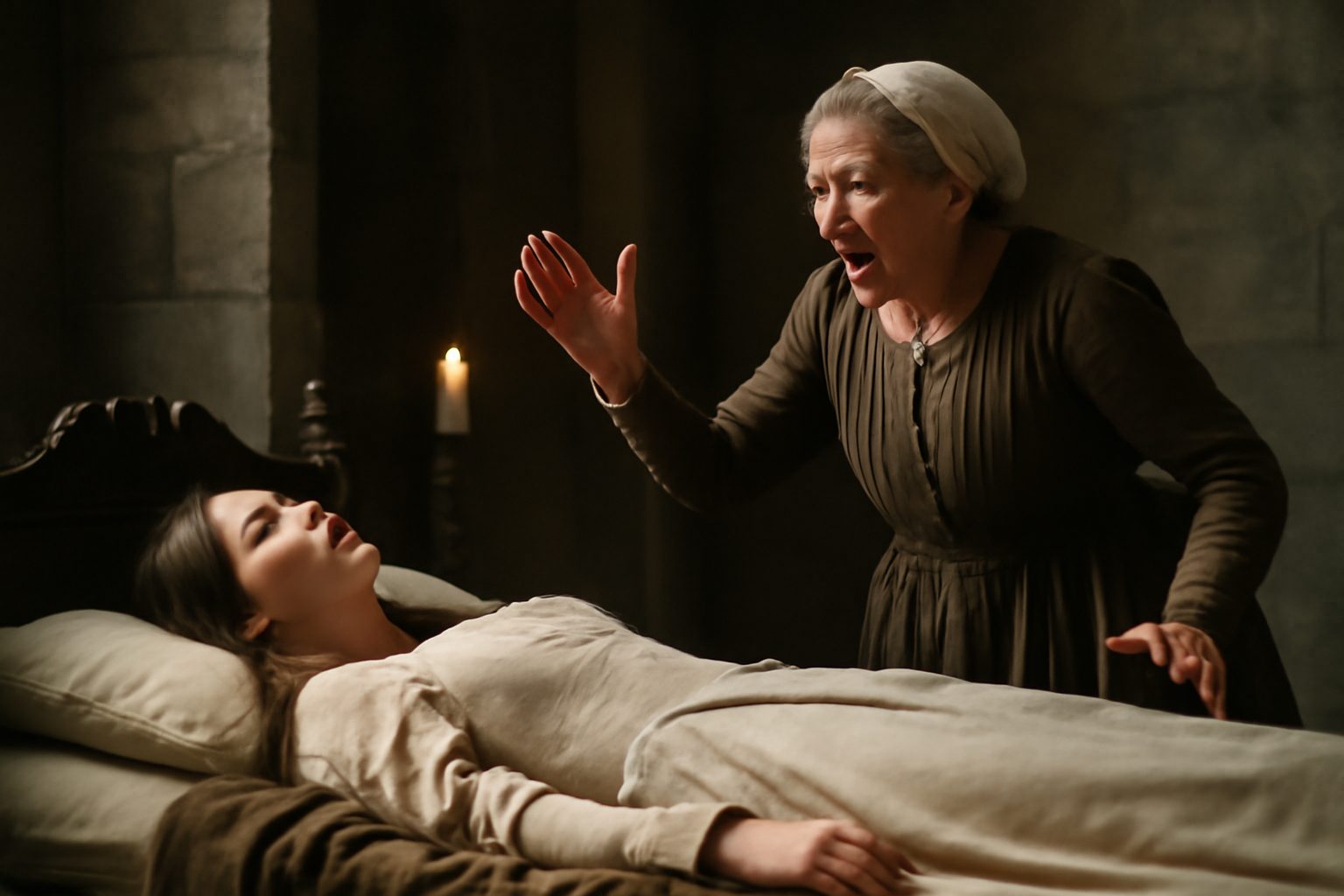
In Act 4, Scene 5 of Romeo and Juliet, the Capulet household awakens to the apparent death of Juliet, who has taken a potion to feign death as part of Friar Laurence's plan. Paris, who was set to marry Juliet that very day, arrives to find her lifeless and speaks these words in grief, believing her to be truly lost. His lament reflects the tragic misunderstanding that drives the play toward its devastating conclusion.
Capulet: "Death, that hath ta'en her hence to make me wail,"
In modern day english, we would say:
Death has taken her away to make me grieve.
Frequently Asked Questions
What does Capulet think has happened to Juliet in this line?
Capulet thinks that death has taken Juliet away, causing him to grieve.
Connections to other verses:
Connections to "Death, that hath ta'en her hence to make me wail"
This verse, spoken by Capulet, expresses his profound grief over Juliet's apparent death. It personifies Death as an entity that has taken Juliet away to cause him sorrow. This theme of personification and deep mourning is echoed throughout the scene.
Related Expressions of Grief
Capulet's lament is immediately followed by his admission of speechlessness in Ties up my tongue, and will not let me speak, showing how overwhelming his sorrow is. Lady Capulet's cry, Dead art thou! Alack! my child is dead, mirrors this despair, emphasizing the finality and personal loss.
Personification of Death
Death is further personified in Death is my son-in-law, Death is my heir, where Capulet bleakly accepts Death as a replacement for Paris. Similarly, Most detestable death, by thee beguil'd portrays Death as a deceitful force, reinforcing the idea of a malicious entity responsible for their suffering.
Transformation of Joy into Sorrow
The verse also connects to the broader transformation in the scene, where wedding preparations turn into funeral arrangements. This is evident in Our wedding cheer to a sad burial feast and Our bridal flowers serve for a buried corse, highlighting the tragic irony and sudden shift from celebration to mourning.
Contrast with the Nurse's Initial Humor
Earlier in the scene, the Nurse's lighthearted attempts to wake Juliet, such as Why, lamb! why, lady! fie, you slug-a-bed!, starkly contrast with the later grief, underscoring the suddenness of the tragedy and making Capulet's lament even more poignant.