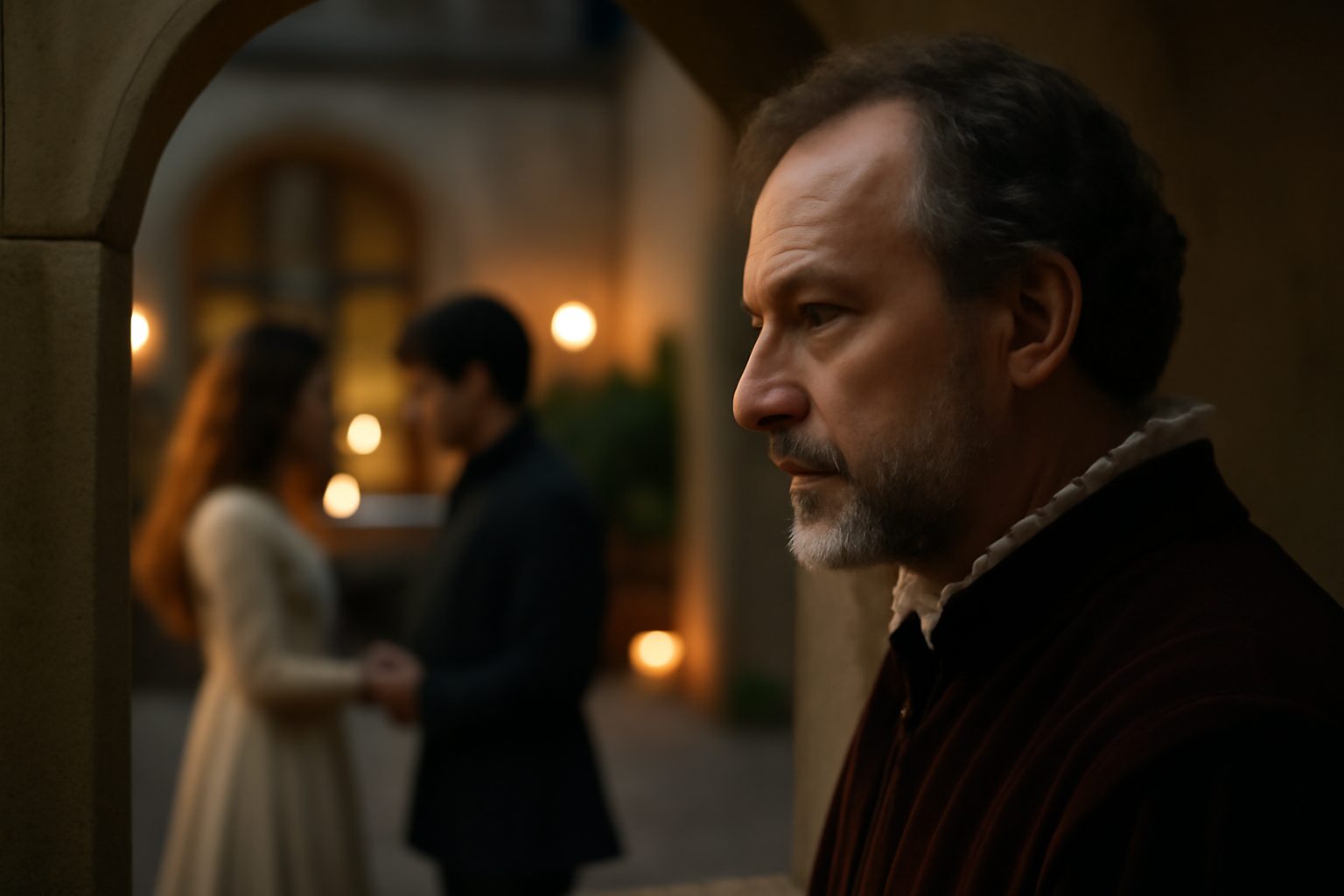
In Act 1, Scene 5 of Romeo and Juliet, the Capulets are hosting a lavish masquerade ball, where Romeo has secretly entered in hopes of seeing Rosaline. Instead, he is instantly captivated by Juliet, and the two share their first exchange. This dismissive phrase is spoken by the Nurse, interrupting their moment as she urgently calls Juliet away to attend to her mother.
Capulet: "Go to, go to;"
In modern day english, we would say:
Cut it out, stop it.
Frequently Asked Questions
What does Capulet mean when he says Go to, go to?
Capulet is telling someone to stop what they are doing or to move along, showing his impatience or dismissal.
Connections to other verses:
Connections to "Go to, go to;" in Act 1 Scene 5
The line "Go to, go to;" is spoken by Lord Capulet during a tense exchange with Tybalt, who is enraged by Romeo's presence at the feast. This phrase is an expression of dismissal or impatience, and it connects thematically and contextually to several other verses in the scene.
Authority and Conflict
Capulet's use of "Go to, go to;" mirrors his earlier assertion of authority in "Am I the master here, or you? go to.", where he challenges Tybalt's defiance. This reinforces Capulet's role as the head of the household, insisting on order. Similarly, in "What, goodman boy! I say, he shall: go to;", he repeats the phrase to emphasize his command over Tybalt, showing consistency in his dismissive tone when dealing with challenges to his authority.
Tybalt's Defiance and Warning
Tybalt's rebellious response is captured in "I'll not endure him.", which directly opposes Capulet's orders and sets up the conflict that "Go to, go to;" attempts to quell. Capulet's warning in "This trick may chance to scathe you, I know what:" further illustrates his attempt to control Tybalt's hot-headedness, linking to the dismissive nature of "Go to, go to;" as a means to prevent escalation.
Social Order and Patience
Capulet's insistence on patience and hospitality is evident in "Therefore be patient, take no note of him:", which aligns with his use of "Go to, go to;" to dismiss Tybalt's anger. The phrase serves as a tool to maintain decorum, much like his earlier call for order in "Show a fair presence and put off these frowns,", highlighting his priority on social harmony over familial grudges.
Contrast with Romantic Moments
While "Go to, go to;" occurs in a context of conflict, it contrasts sharply with the romantic and poetic exchanges elsewhere in the scene, such as Romeo's awe upon seeing Juliet in "Did my heart love till now? forswear it, sight!" and their shared sonnet beginning with "[To JULIET] If I profane with my unworthiest hand". This juxtaposition emphasizes the tension between the lovers' budding romance and the underlying family feud that Capulet tries to suppress with phrases like "Go to, go to;".