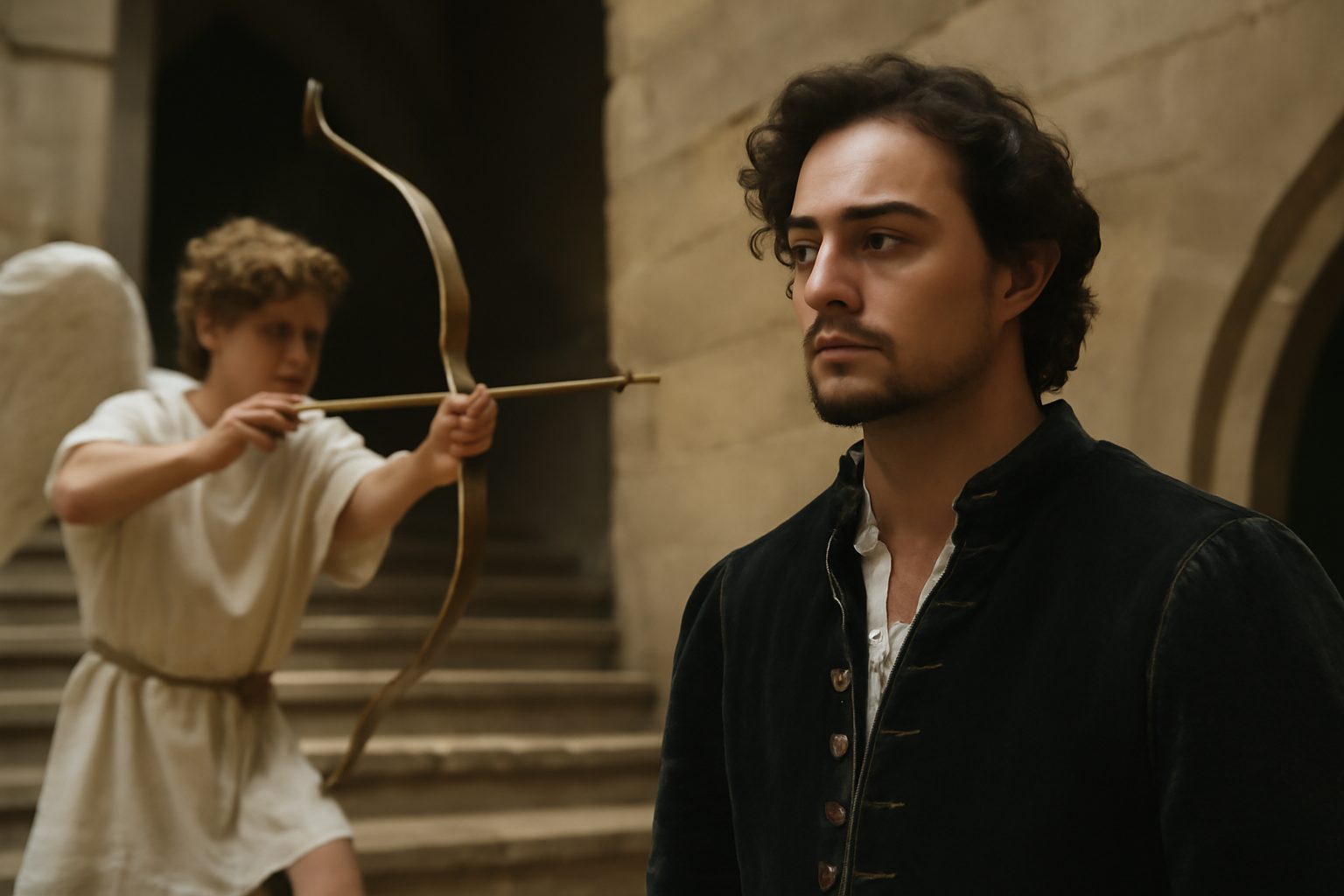
In Act 1, Scene 4 of Romeo and Juliet, Mercutio mocks Romeo's lovesick demeanor by delivering a vivid, exaggerated speech about Queen Mab, the fairy who influences people's dreams. This particular line follows Mercutio's description of how soldiers dream of battle and violence, showcasing his wild imagination and playful cynicism. The remark underscores the contrast between Romeo's romantic idealism and Mercutio's more worldly, satirical perspective.
Mercutio: "And then dreams he of cutting foreign throats,"
In modern day english, we would say:
In his dream, he imagines slitting the throats of enemies in distant lands.
Frequently Asked Questions
What does Mercutio say Romeo dreams about in this line?
Mercutio says Romeo dreams about fighting and killing enemies in foreign lands.
Connections to other verses:
Connections to "And then dreams he of cutting foreign throats"
The verse "And then dreams he of cutting foreign throats" is part of Mercutio's Queen Mab speech, which explores how dreams reflect the desires and anxieties of different people. It connects thematically and structurally to several other verses in the scene.
Dreams and Professions
This line describes a soldier's violent dream, linking directly to "Sometime she driveth o'er a soldier's neck", which introduces the soldier as one of Mab's victims. It also parallels other profession-specific dreams, such as "O'er lawyers' fingers, who straight dream on fees" and "O'er courtiers' knees, that dream on court'sies", showing how Mab's influence manifests according to one's occupation.
Continuation of the Soldier's Dream
The violent imagery continues in "Of breaches, ambuscadoes, Spanish blades", elaborating on the soldier's martial fantasies, and "Of healths five-fathom deep; and then anon", which transitions to another aspect of the dream. The abrupt end of such dreams is highlighted in "Drums in his ear, at which he starts and wakes", emphasizing their fleeting nature.
Mercutio's Skepticism
Mercutio's speech culminates in his dismissal of dreams as "the children of an idle brain", born of "vain fantasy". This skepticism is echoed when Romeo interrupts him with "Peace, peace, Mercutio, peace!", to which Mercutio retorts "Thou talk'st of nothing", reinforcing the idea that dreams, including the soldier's violent vision, are insubstantial.
Foreshadowing and Tone
While Mercutio mocks dreams, Romeo's own foreboding about "Some consequence yet hanging in the stars" contrasts with Mercutio's levity. The soldier's dream of violence ironically foreshadows the play's tragic events, much like Romeo's fear that the night's events will "expire the term of a despised life".