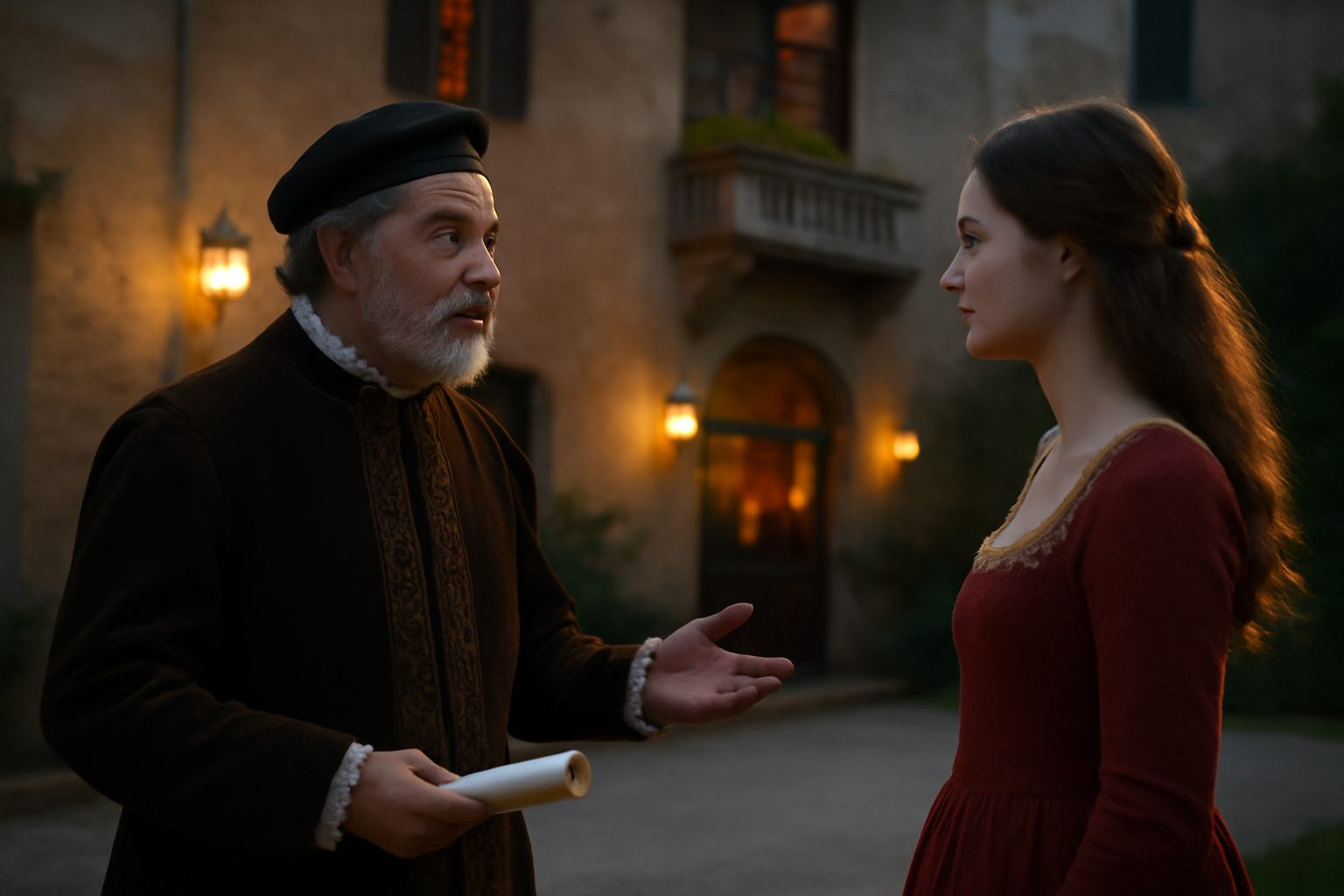
In Act 1, Scene 2 of Romeo and Juliet, Capulet speaks to Paris, a nobleman seeking Juliet's hand in marriage. He acknowledges the social standing and reputation of both Paris and another suitor, implying they are worthy of consideration. This line reflects the importance of honor and status in the matchmaking customs of Verona's elite.
Paris: "Of honourable reckoning are you both;"
In modern day english, we would say:
You both come from respected families.
Frequently Asked Questions
Who is Paris speaking to in this line?
Paris is speaking to Lord Capulet and another person, praising their honorable reputation.
What does Paris mean by 'honourable reckoning'?
He means that the people he is addressing are well-respected and of good standing in society.
Connections to other verses:
Connections to "Of honourable reckoning are you both"
The verse "Of honourable reckoning are you both" is spoken by Capulet to Paris, acknowledging the esteemed status of both their families. This line sets the tone for the scene's exploration of reputation, social standing, and the responsibilities that come with nobility.
Connection to Familial Honor and Peace
This idea of honorable standing is immediately preceded by Capulet's reflection on the long-standing feud with the Montagues in "And pity 'tis you lived at odds so long", emphasizing the waste of such honorable status on conflict. It is also reinforced by the earlier line "For men so old as we to keep the peace", highlighting the duty of noble families to maintain social harmony.
Connection to Courtship and Social Expectations
The concept of honor extends to the discussion of Juliet's marriage. Capulet's conditional agreement in "An she agree, within her scope of choice" and "Lies my consent and fair according voice" shows that honorable reckoning involves respecting personal choice within social norms. His description of Juliet as "the hopeful lady of my earth" further ties honor to lineage and future legacy.
Connection to the Feast and Social Gatherings
The honorable status mentioned is showcased through Capulet's feast, described in "This night I hold an old accustom'd feast" and "Whereto I have invited many a guest". The gathering of esteemed guests, like those listed in "Signior Martino and his wife and daughters" and others, reflects the social embodiment of honor and reckoning.
Contrast with Romeo's Perspective
Romeo's later despair over Rosaline contrasts with this theme of honor. His lines, such as "Ay, mine own fortune in my misery" and "Not mad, but bound more than a mad-man is", show a personal struggle that exists outside the societal framework of honorable reckoning, highlighting different facets of nobility and emotion.