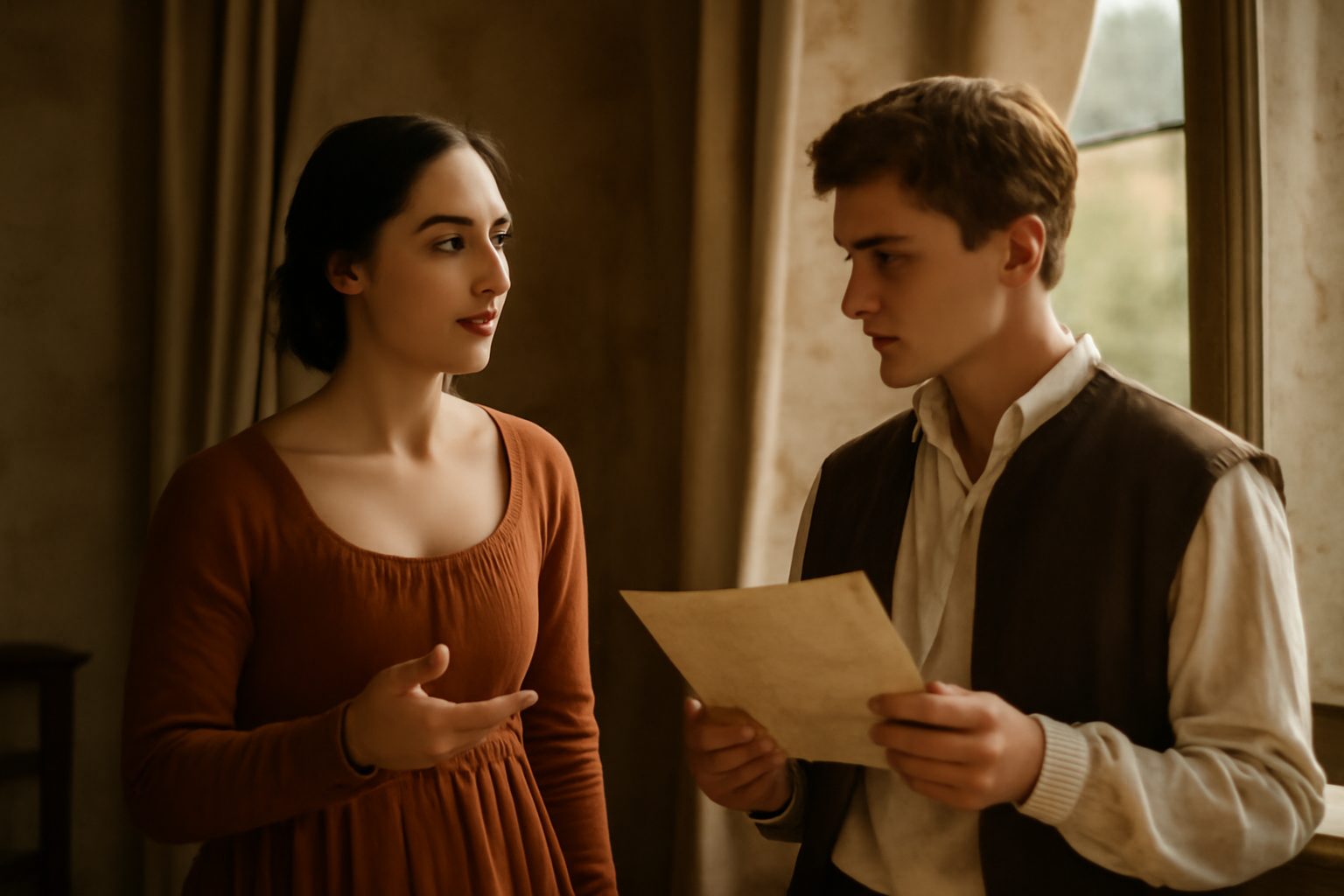
In Act 1, Scene 2 of Romeo and Juliet, a servant of the Capulet household is tasked with delivering invitations to a feast but cannot read the guest list. He encounters Romeo and Benvolio, asking for their help in identifying the names. The phrase in question is the servant's response when asked who the list belongs to, revealing his allegiance to the Capulets.
Servant: "My master's."
In modern day english, we would say:
This is my boss’s house.
Frequently Asked Questions
Who does the servant belong to in Act 1 Scene 2 of Romeo and Juliet?
The servant belongs to his master.
Connections to other verses:
Connections to "My master's."
The verse "My master's." is spoken by the servant Peter in response to Romeo's question, "Whose house?" This line is part of a dialogue that reveals the servant's role and the context of the Capulet feast.
Immediate Context and Dialogue Flow
This line directly follows "Whose house?" and precedes "Indeed, I should have ask'd you that before.", showing the servant's realization of his oversight in not identifying the host earlier. It also connects to "Now I'll tell you without asking: my master is the", where he elaborates on his master's identity, emphasizing his duty and the household he serves.
Link to the Feast and Invitations
The servant's reference to "my master" ties to Capulet's preparations for the feast, mentioned in "This night I hold an old accustom'd feast" and "Whereto I have invited many a guest". The servant's task of delivering invitations, as seen in "Find them out whose names are written here!" and "sent to find those persons whose names are here", contextualizes his role and the importance of the feast.
Social Hierarchy and Servant's Perspective
The phrase reflects the servant's position and the social structure, echoing themes in lines like "written, that the shoemaker should meddle with his" and "yard, and the tailor with his last", which humorously comment on roles and duties. It also contrasts with the nobility discussed in "Of honourable reckoning are you both", highlighting the divide between masters and servants.
Narrative Function and Foreshadowing
This interaction inadvertently leads Romeo to the feast where he meets Juliet, linking to foreshadowing in "Sups the fair Rosaline whom thou so lovest" and the transformative moment in "Take thou some new infection to thy eye". The servant's simple reply thus becomes a catalyst for the play's central romance.